


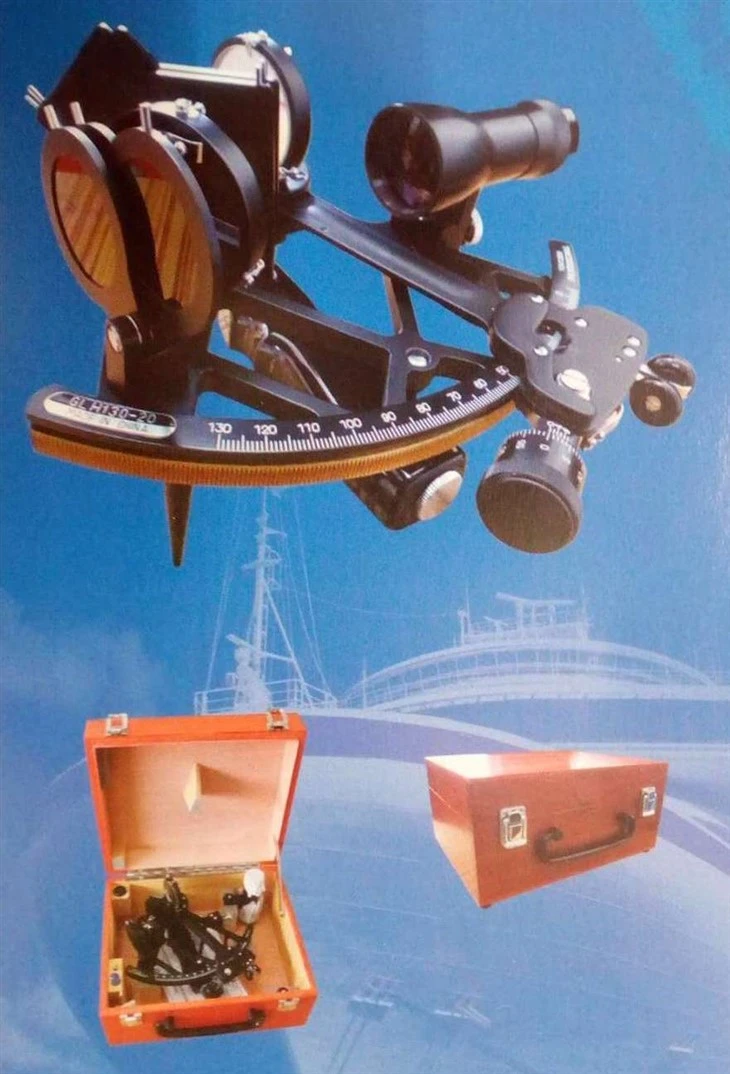


Product Introduction
The marine sextant is a kind of reflection type angular measuring optical instrument, chiefly used for measuring the altitude of celestial bodies to obtain a position in navigation. The VERTICAL ERROR, LATERAL ERROR and INDEX ERROR of the instrument should be adjusted and predetermined before use.
Product Parameter (specification)
| Type | GLH130-20 |
| Measuring range | -5~130 degree |
| Accuracy | (+,-) 10" |
| Readability | 12" |
| Working Temperature range | -30°~+50℃ |
| Telescope | 3.5x40 |
| Lamp voltage | 3V |
| Net weigh | 1.8kg |
| Type | GLH130-40 |
| Measuring range | -5~130 degree |
| Accuracy | (+,-)20" |
| Readability | 12" |
| Working Temperature range | -30°~+50℃ |
| Telescope | 3.5x40 |
| Lamp voltage | 3V |
| Net weigh | 1.2kg |
Product feature and application
- High-Quality Optics: Enhanced visibility and clarity for precise readings.
- Adjustable Telescope: Facilitates accurate alignment and measurement.
- Durability: Built to withstand harsh marine conditions.
- Portability: Lightweight and easy to handle for on-deck use.
- Ideal for sailors and navigators, the GLH130-20/40 nautical sextant is a reliable tool for traditional celestial navigation, complementing modern electronic navigation systems.
Product details
Sextant GLH130-20
The Sextant GLH130-20 is a reliable marine navigation instrument, designed for those who require higher accuracy and durability. Key features include:
Optical Clarity: It features high-quality optics for enhanced visibility during navigation.
Angle Range: This model typically measures angles range -5~130 degree, providing sufficient range for most navigation needs.
Rugged Build: Constructed from robust materials to resist corrosion and damage from marine conditions.
Simplified Use: Designed for easy handling and operation, making it suitable for both experienced navigators and beginners.
Lightweight Design: Its lightweight nature enhances portability, allowing for easy storage and transportation.
Adjustable Components: Features adjustable telescopes and settings for improved accuracy in measurements.
Sextant GLH130-40
The Sextant GLH130-40 is a high-precision marine navigation instrument, ideal for sailors and navigators who rely on traditional celestial navigation methods. Key features include:
Optical Design: The GLH130-40 boasts high-quality optics, ensuring clear visibility and accurate readings of celestial bodies and the horizon.
Angle Measurement: It can measure angles up to 140 degrees, allowing for versatile use in navigation.
Durable Construction: Made with corrosion-resistant materials, the sextant is built to withstand harsh marine environments.
Adjustable Telescope: The adjustable telescope aids in precise alignment for accurate angle measurements.
Portability: Lightweight and compact, it is easy to handle and transport, making it suitable for use on small boats and larger vessels.
Comparison
Compared to the GLH130-40, GLH130-40 is more accurate, weight is also a little heavier than GLH130-40
Deliver, shipping and service
Packed in Wooden Box
Download
FAQ
Q: What is a nautical sextant?
A: - A nautical sextant is an instrument used to measure the angle between a celestial body (like the sun or stars) and the horizon. This measurement helps navigators determine their latitude and longitude.
Q: How does a sextant work?
A: - A sextant uses a system of mirrors and lenses to reflect the image of a celestial body into the line of sight of the horizon. By adjusting the angle, the navigator aligns the two images and reads the angle from the scale.
Q: What is the primary use of a sextant?
A: - The primary use of a sextant is for celestial navigation, allowing sailors to determine their position at sea by measuring the altitude of celestial bodies.
Q: How do I take a measurement with a sextant?
A: - To take a measurement:
1. Hold the sextant horizontally.
2. Look through the telescope and locate the celestial body.
3. Adjust the micrometer until the body appears to touch the horizon.
4. Read the angle from the scale.
Q: What celestial bodies can I measure with a sextant?
A: - Commonly measured bodies include the sun, moon, planets, and prominent stars. The sun is often used during the day, while stars are used at night.
Q: Do I need additional tools to use a sextant?
A: - Yes, you typically need a reliable timekeeping device (like a chronometer) to record the exact time of your measurement, along with nautical tables or software for calculations.
Q: Are sextants accurate?
A: - Yes, sextants can provide highly accurate measurements if used correctly, typically within a few arc minutes. However, the accuracy depends on the skill of the user and the conditions.
Q: How do I maintain my sextant?
A: - Keep it clean and dry, store it in a protective case, and periodically check for calibration. Avoid exposing it to extreme temperatures and humidity.
Q: Can I use a sextant in cloudy conditions?
A: - Sextants are primarily designed for clear visibility. In cloudy conditions, measuring the sun's altitude can be challenging, but some navigators may use the moon or stars if visible.
Q: Is celestial navigation still relevant today?
A: - While modern electronic navigation systems (like GPS) are widely used, celestial navigation remains relevant, especially for backup navigation and in situations where electronic systems fail.
Q: What is the difference between a sextant and an octant?
A: - An octant measures angles up to 90 degrees, while a sextant can measure angles up to 120 degrees. Sextants also typically have better optics and precision.
Q: Can beginners use a sextant?
A: - Yes, beginners can learn to use a sextant with practice and proper instruction. Many sailing schools offer courses on celestial navigation.
Q: What certifications can you provide?
A: Make certificate.
Q: What are the payment terms of EMF Marine?
A: Normally T/T 100% in advance for small orders. T/T 30% against order and balance before shipment for large orders. But we can discuss on special payment terms for some special orders.
Q: What are your general delivery terms?
A: EXW, FOB are the general terms we offer. CIF, FCA is less and less offered due to quick changes on freight in current unstable shipping market.
Hot Tags: nautical sextant, China nautical sextant manufacturers, suppliers, factory, Nautical Sextant, Ship Nautical Sextant, clocks and meters


