

1 Preparation Before doing various performance tests on the outer material, it should be washed 5 times according to the method in Appendix A of GB 8965-1998.
2 Flame retardant performance test The flame retardant performance test is carried out in accordance with GB/T 5455-1997, and the results should comply with the provisions of 5.2.1.1, 5.2.3.1, 5.2.4, etc.
3 Surface moisture resistance test The surface moisture resistance test is carried out in accordance with GB/T 4745-1997, and the results should comply with the provisions of 5.2.1.2.
4 Breaking strength test The breaking strength test is carried out in accordance with GB/T 3923..1-1997, and the results should comply with the provisions of 5.2.1.3.
5 Tear strength test The tear strength test is carried out in accordance with GB/T 3917.3-1997, and the results should comply with the provisions of 5.2.1.4.
6 Thermal stability performance test The thermal stability performance test method shall be carried out in accordance with Appendix A, and the results shall comply with the provisions of 5.2.1.5, 5.2.2.3, and 5.2.3.2.
7 The mass per unit area shall be measured using a pan balance with a weighing range of 0 g to 500 g and a sensitivity of 0.5 g, and the results shall comply with the provisions of 5.2.1.6.
8 Color fastness test The color fastness test method shall be carried out in accordance with GB/T 3920-1997, and the results shall comply with the provisions of 5.2.1.7.
9 Hydrostatic pressure resistance performance test The hydrostatic pressure resistance performance test shall be carried out in accordance with GB/T 4744-1997, and the results shall comply with the provisions of 5.2.2.1.
10 Water vapor permeability test The water vapor permeability test method shall be carried out in accordance with GB/T 1037-1997, and the results shall comply with the provisions of 5.2.2.2.
11 Overall thermal protection performance test The thermal protection test method shall be carried out in accordance with Appendix B, and the results shall comply with the provisions of 5.3.
12 Needle spacing density test Take any 3 cm on the protective clothing for measurement, and the results shall comply with the provisions of 5.3.
13 Color difference test When measuring the degree of color difference, the measured part should be consistent in yarn direction, and a light source of 600 lx or above should be used. The incident light is about 45° to the measured object, and the observation direction is roughly perpendicular to the measured object, and the distance is 60 cm for visual inspection. Compared with the GB 250 sample card, the results shall comply with the provisions of 5.5.
14 Seam breaking strength test The seam breaking strength test method shall be carried out in accordance with GB/T 13773-1992, and the results shall comply with the provisions of 5.6. 6.15 Performance test of reflective marking tape
15.1 Test of retroreflective coefficient a) Test environment: temperature 20℃±2℃, humidity 65%±5%; b) Sample size and quantity: 3 pieces of 200mm×50mm reflective material; c) The observation angle of the retroreflective coefficient measuring instrument can be adjusted in the range of 12′ to 2°, and the minimum scale value should not be greater than 0.01°; the incident angle can be adjusted in the range of 0° to 40°, and the minimum scale value should not be greater than 1°; d) After measuring 5 times in the horizontal and vertical directions respectively, the measured data are averaged, and the results should comply with the provisions of 5.7.1.
15.2 Heat resistance test First place the sample in a drying oven at a temperature of 260℃±5℃, take out the sample after 5 minutes of testing, and then proceed according to the method of 6.15.1, and the results should comply with the provisions of 5.7.2.
15.3 The size of the washing resistance test sample is 200mm×50mm. It is washed 25 times according to the method in Appendix A of GB 8965-1998. The result shall comply with the provisions of 5.7.4.
15.4 The size of the high and low temperature performance test sample is 200mm×50mm. It is placed in an environment of 50℃±2℃ for 12 hours. After being taken out, it should be immediately transferred to an environment of -30℃±2℃ and placed for 20 hours. The result shall comply with the provisions of 5.7.5.
16 The high temperature resistance performance test of hardware is to place the sample in a drying oven at a temperature of 260℃±5℃. After the test for 5 minutes, the sample is taken out and measured by visual inspection. The result shall comply with the provisions of 5.8.
17 The high temperature resistance performance test of sewing thread is to place the sample in a drying oven at a temperature of 260℃±5℃. After the test for 5 minutes, the sample is taken out and measured by visual inspection. The result shall comply with the provisions of 5.9.
18 The mass shall be measured by a weighing instrument with a weighing range of 0 g to 10 000 g and an accuracy of not less than Class 3, and the result shall comply with the provisions of 5.10.
19 The appearance quality shall be measured by visual inspection, and the result shall comply with the provisions of 5.11.
The special protective clothing worn by firefighters when they are close to the flame area and are exposed to strong radiant heat during fire fighting and rescue is used to insulate their upper and lower torsos, heads, hands and feet, including firefighting jackets, firefighting pants, firefighting hoods, firefighting gloves and fireproof foot covers.
The firefighting suit is composed of multiple layers of fabrics such as the outer layer, the heat insulation layer, and the comfort layer. The materials of this combination can be made into a single layer or multiple layers. The outer layer of the heat insulation suit should be made of a metal aluminum foil surface material that reflects radiant heat and can meet the basic clothing manufacturing process requirements and the performance requirements of the corresponding standards for auxiliary materials.
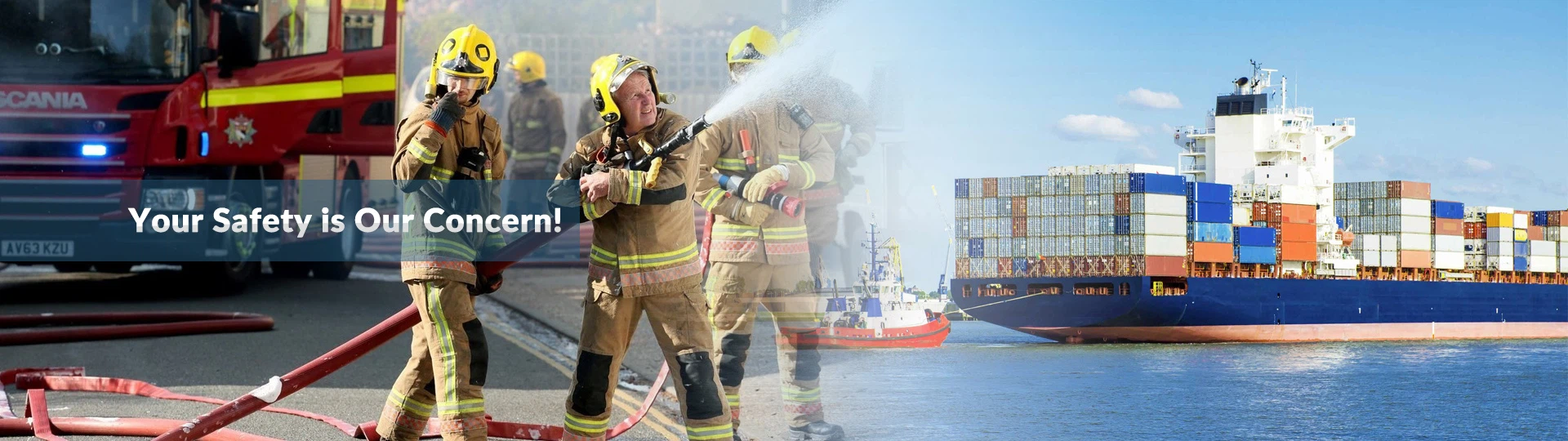
Test methods for firefighting clothing
Oct 01, 2024
Leave a message
No Information
Next